Side A
Side A
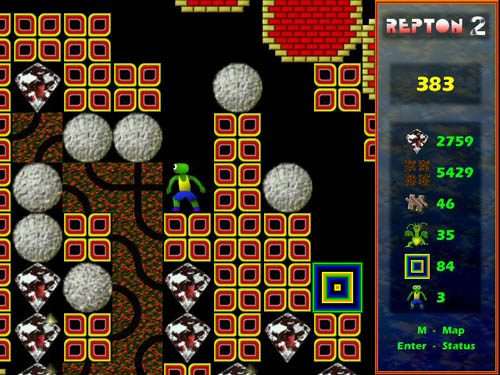
Repton 2
Superior Software
Repton 2 took the first game apart and reassembled it as one connected world, which made it markedly harder and considerably less forgiving.
Standing in 2026
Still sold
Included in the Repton conversions Superior Interactive lists for sale, verified by direct request.
Publisher: Superior Interactive
Written from the record this site kept at the time, and from what can be checked today.
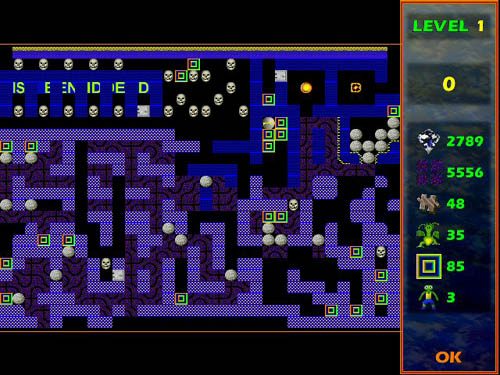
Rather than a sequence of discrete screens, the second game links its areas by transporters into a single space that has to be solved as a whole. A mistake made early can strand the player much later, with no way back and no indication that anything went wrong at the time. It is the entry in the series that experienced players tend to name as the difficult one, and the reason is structural rather than a matter of tighter level design.
The design also explains why the third game returned to discrete levels and added an editor. A single interlocking world is impressive and almost impossible to author for, whereas separate screens can be built, shared and thrown away individually.
It is worth noting what the second game's structure cost it commercially. A single interlocking world cannot be sampled: a demo of one area teaches nothing about the puzzle, because the puzzle is the relationship between areas. Games that can be demonstrated in a slice have always been easier to sell, and that is part of why the third game, built from discrete screens, became the one that spread.
The commercial context is worth stating. This was a full-price release in a market that within two years would be dominated by budget cassettes, and its structure — one large interlocking world rather than a set of samplable screens — is exactly the kind of design that becomes hard to sell when buyers start expecting to try before paying.
The scenarios are named on the record and the way they are weighted is the most exact measurement of difficulty this archive holds for the series. Three are listed — Beginner, Message and Caverns — and the save points are distributed two, three and fourteen across them. Fourteen save points in one scenario is not generosity; it is an admission that the section cannot reasonably be completed in one unbroken attempt, and it puts a number on how much harder the advanced material is than the opening. The same listing offers a level editor and the ability to drop the player's own high-resolution images into a design as puzzle pictures, which is the first appearance in the series of the idea the third game would build its whole afterlife on.
Established here: publisher, machines, the interlocking structure, and current availability through the conversions. Not established: the exact release month, or whether the transporter layout was altered between the cassette and disc releases.
Answers are limited to what the record and a direct check support.
Its areas are linked into one continuous world by transporters rather than being separate screens, so an error made early can make a later section unsolvable with no warning at the time.
It is part of the Repton conversion range Superior Interactive lists for sale, confirmed by direct request on 31 July 2026.
Not meaningfully. The areas are linked into one space, so progress depends on the order in which they are solved and an early error can strand you much later.
A single interlocking world is almost impossible to author for. Discrete screens can be built, shared and discarded individually, which is what made the third game's editor viable.
Other entries sharing this one's genre or machine.
Side A
Side A
Side A