Side A
Side A
Repton
Superior Software
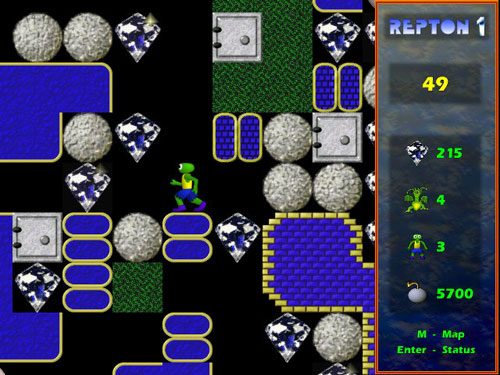
The first Repton established the whole grammar of the series: dig earth, drop boulders, collect diamonds, and accept that the puzzle is entirely your own fault.
Standing in 2026
Still sold
Sold as part of the Repton conversions listed by Superior Interactive, verified by direct request.
Publisher: Superior Interactive
Written from the record this site kept at the time, and from what can be checked today.
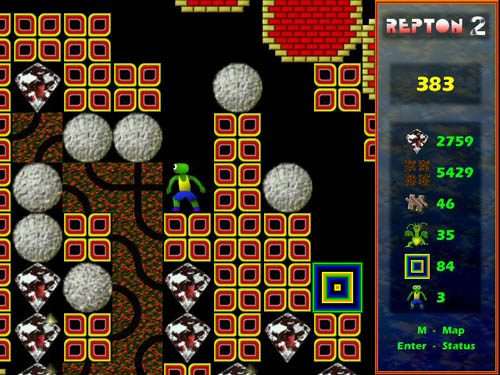
Everything the later games elaborated is already present here in its plainest form. The player digs, the boulders fall, the diamonds are counted, and the exit opens. No time pressure beyond the level design itself, and no randomness — which means every screen has a solution and the only question is whether you can see it before you commit a move that cannot be taken back.
It is worth playing the first game before the third, because the third is where the series became a platform and the first is where it was still an argument about whether a deterministic puzzle could hold attention. It could, and the evidence is the twenty years of level packs that followed.
There is a distinction here that is easy to collapse and worth keeping. The listing this site carried was not for the 1985 cassette but for the Windows conversion, and the conversion is the more thoroughly specified of the two. It shipped thirty-two main levels, opening with deliberately gentle ones and rising through a scenario named Cascade to what the seller described as the hardest Repton 1 levels ever devised. Alongside them sat twenty further levels built for children between three and nine — an easier game inside the same product, aimed at an audience the original cassette had never been sold to.
The conversion also shipped a level editor, which is the fact most often stated the wrong way round. The editor is usually credited to the third game, and on the Acorn machines that is correct; on Windows the first game was sold with one as well, together with an open invitation to send finished levels back to the publisher for possible release. At $19.95 it was priced as a current product rather than as a nostalgia item, and it asked for Windows 95 through XP with a 300MHz Pentium II and 32MB of memory.
The distribution history is the reason this entry can be written with any confidence at all. A cassette pressed in 1985 exists in lofts and in collections whether or not anyone is selling it, and the conversions keep a legal route open alongside that. Almost every Windows-era entry in this archive lacks both, which is why their records are thinner despite being two decades newer.
The record supports the publisher, the machines and the current commercial status. It does not establish a precise release month, and this archive does not supply one. The year is well attested; the finer dating is not.
Answers are limited to what the record and a direct check support.
The series ran to several entries on the BBC Micro and Electron, with the third being the one that added a level editor on those machines and the one most widely converted since.
No, the games are self-contained. The first is useful context because it shows the mechanics before the editor turned the series into something players extended themselves.
Not on the Acorn machines. The Windows conversion sold under the same name did, and the listing this archive holds advertises it alongside an invitation to submit levels to the publisher, so the answer depends on which release is meant.
Thirty-two main levels rising through a scenario named Cascade, plus twenty separate levels designed for children aged three to nine. Both figures are the seller's, taken from the listing this archive holds.
Generally regarded as easier than the second, which restructured the game into one continuous world. Difficulty across the series is not linear, and the second entry is the one experienced players single out.
Other entries sharing this one's genre or machine.
Side A
Side A
Side A