Side A
Side A
Ravenskull
Superior Software
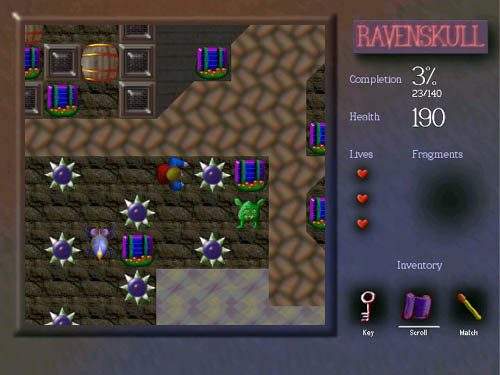
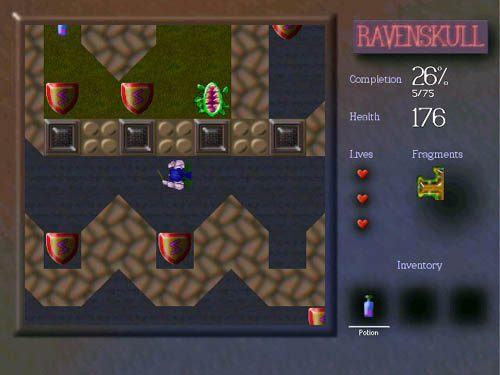
Ravenskull sits between the puzzle games and the arcade adventures, asking the player to map a castle as carefully as they solve each room inside it.
Standing in 2026
Still sold
Superior Interactive lists conversions of its back catalogue for sale; the site responded to a direct request on 31 July 2026.
Publisher: Superior Interactive
Written from the record this site kept at the time, and from what can be checked today.
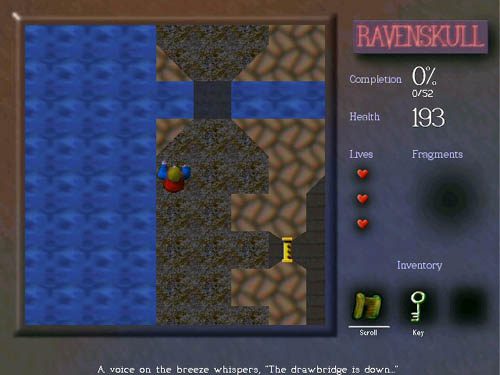
The structure is a large connected map rather than a level list, and progress depends on carrying the right item to the right place. Where Repton asks the player to think one screen ahead, Ravenskull asks them to think about the whole building — which door the key opens, which route the boulder blocks, which corridor becomes impassable once a wall is dug through.
It rewards the habit that defined the era: drawing the map on paper. There is no in-game automap and no reminder of what has been picked up, so the notebook beside the keyboard is part of the equipment rather than an optional aid.
The listing this site carried was for the Windows conversion rather than the cassette, and it is far more fully specified than the entries around it. Two adventures ship together: the quest opens in Castle Ravenskull and moves on to Castle Danube, described as the larger and the more dangerous of the two, for eight large levels between them. Saving is allowed only at particular locations, and those locations are not marked — the conversion states they are found only after substantial progress, which makes discovering a save point a reward in its own right rather than a convenience.
The character system is the part with no equivalent elsewhere in this archive. Four types are offered — adventurer, warrior, wizard and elf — each with its own special abilities, and each in a male and a female version, giving eight playable figures. A choice of protagonist gender in a game of this lineage is worth noting because it was not standard practice, and here it is presented as an ordinary line in a feature list rather than as a selling point.
The conversion also went further than the Repton editor it sits beside. Three authoring tools shipped with it — an adventure editor, a level editor and a tile-set editor for dropping the player's own graphics into a design — and above them a scripting language named RavenScript for building original puzzles into complete adventures of one's own. That is a game sold with the means to replace its own content, at $19.95, on Windows 95 through XP with a 400MHz Pentium II and 32MB of memory.
The record establishes the publisher, both machines, the genre and current availability. It does not establish the designer's name, and this archive does not attribute it. Several names are associated with Superior Software titles of the period and matching a specific one to this game is not something the source supports.
Answers are limited to what the record and a direct check support.
An arcade adventure built on a single large connected map, mixing item-fetching and route-planning with the boulder-and-earth puzzle logic Superior Software used elsewhere.
In practice yes. The game provides no automap and no inventory reminder, so keeping notes was the normal way to play it and still is.
The Windows conversion offers four types — adventurer, warrior, wizard and elf — each with its own abilities and each in a male and a female version, so eight figures in total.
The conversion shipped an adventure editor, a level editor and a tile-set editor for importing your own graphics, together with a scripting language named RavenScript for authoring original puzzles. That is what the listing this archive holds advertises.
Not established here. Superior Software published it; matching a specific designer to this title is not something this archive's record supports, so no name is given.
Other entries sharing this one's genre or machine.
Side A
Side A
Side A