Gibbage — a cartoon deathmatch built for a room, not for a ranking
Gibbage is an arena deathmatch played for laughs across twenty-seven maps, alone or with somebody sitting next to you. Everything commercially interesting about it follows from that second option.

Twenty-seven arenas and a sense of humour
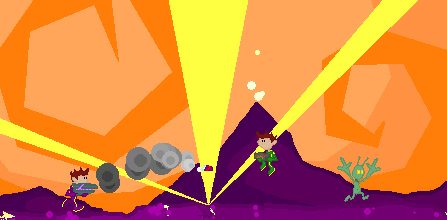
The arenas are the selling point and they are deliberately silly: a hospital overrun by zombies, the roof of a moving train, the inside of an alien creature. Power-ups, special moves and a weapon set sit on top, along with team play. None of that is unusual for an arena game; what is unusual is the tone, which treats the whole genre as a comic form rather than a competitive one.
That places it in a recognisably British lineage. The platform and arcade games this archive holds the most of tend to be funny on purpose, and a deathmatch played for laughs is the same instinct applied to a genre that had by 2006 become extremely serious about itself elsewhere.
The feature list commits to the tone rather than apologising for it. Alongside the maps, the power-ups and the team setup that tracks player statistics, it advertises unnecessary levels of gore — as a selling point, in those words. An arena game of 2006 selling itself on excess it openly calls unnecessary is not positioning itself against the serious competitive titles of its year; it is declining to be compared with them at all.
The cost of building for a room
An independent studio making an arena game in 2006 had two options. Build for the internet and take on servers, matchmaking, patching and anti-cheat, all of which cost money indefinitely; or build for two people at one keyboard and ship. Gibbage advertises single and two-player play and no online mode, which tells you which choice was made and why the game could be finished at all.
The commercial consequence is unkind. A game that is at its best with somebody else in the room is hard to demo, hard to review and hard to sell to a person browsing alone — and none of those difficulties are arguments about the design. They are arguments about distribution, and distribution won often enough that fewer games like this were made than the idea deserved.
What survives is a feature list, three screenshots and a review. What does not survive is any way to test the claim, because the thing being claimed is what happens between two people, and no record preserves that.
The price on the page is the single most era-specific thing about it. The full version was offered at roughly six pounds or ten dollars — and the listing said roughly, in as many words, rather than naming a figure. A seller who cannot state their own price to the penny is a seller taking payment through whatever arrangement was available that month, in a currency that depended on where the buyer happened to be. Nothing else in this archive dates its own commercial machinery quite so precisely.
- Arenas
- Twenty-seven, as advertised
- Players
- Single or two-player, with team play
- Price then
- About £6 / $10, as stated
- Machine
- Windows 95 to XP, 500MHz, 64MB
- Review dated
- 28 May 2006
- Entry
- Gibbage in the index
What the review can and cannot tell you
It can tell you what the game contained, how it was sold and what its author thought was worth advertising. Those are matters of record and they are reproduced here without embellishment.
It cannot tell you whether the game was fun, because that judgement was made in 2006 by somebody with a particular set of comparisons available and a particular person sitting next to them. This archive keeps reviews separate from index entries precisely so that the difference between a record and a judgement stays visible.
Where a claim on this page comes from the page this site ran at the time, it is presented as such. Where something is not established — the publisher, the release year, whether the game can still be obtained — the entry says so rather than filling the gap with something plausible.
Questions about Gibbage
How many arenas does Gibbage have?
Twenty-seven, as advertised on the page this archive holds. That is the seller's figure rather than a count verified by play.
Can Gibbage be played alone?
Yes. Single and two-player modes were both advertised, along with team play. There was no online mode, which is the decision the rest of the review turns on.
Does the review say whether the game was any good?
It carried a judgement made in 2006, and this archive does not restate it as a current verdict. Descriptions of what a game contained do not date; opinions about it do.
What did Gibbage cost?
The page offered the full version at approximately six pounds or ten dollars, stated in those approximate terms rather than as a fixed figure. That is what the listing said; no order record is held here.
When was this review published?
The review index dates it 28 May 2006. The page itself was recorded in September 2006, which is why both dates appear on this entry rather than one standing in for the other.