Bonbon Quest — the platform game this site reviewed twice over
Bonbon Quest is one of a small number of titles in this archive that got both a listing and a full two-part review, which makes it unusually well documented for a game of its size.

Why this one got two pages
The two-page format was not handed out freely. Most titles on this site received a description, a screenshot strip and system requirements. Bonbon Quest received that and then a review across two further pages, which at minimum indicates the game held attention here for longer than a listing required.
That is a soft signal and it is worth being honest about how soft. It does not establish that the game was better than the titles that got one page. It establishes that somebody wanted to write about it, which in a catalogue assembled by two or three people is a different thing from a verdict.
The platform game in 2006
By the middle of the decade the shareware platform game was a mature and crowded form. The mechanics were settled, the audience knew them, and differentiation came from tone and from level design rather than from systems. That put a lot of weight on presentation, which is where most of these games either found an audience or did not.
It also means the surviving descriptions read very similarly to one another, and the differences that mattered to players at the time are exactly the differences a text record cannot preserve. This is a limit of the archive rather than of the games: what a platform game felt like at sixty frames a second is not recoverable from a page about it.
This one differentiates itself in the two places available to it. It has named protagonists — Artemus and Hannah — rather than an unnamed avatar, and it has a setting: the collectables are sweets and the opposition is Halloween creatures. Naming two characters commits a platform game to a two-player mode being part of the premise rather than an added option, which is what the listing then advertises. In a crowded form, a reason for the second player to exist is differentiation that costs nothing to build.
- Genre
- Platform, candy-collecting
- Studio
- Oliver Pearl, Brittany
- Levels
- Fifty-four, as advertised
- Players
- One or two
- Price then
- $19.95 for the full version
- Machine
- Windows 95 to XP, DirectX 8
- Review dated
- 29 June 2006
- Attribution
- From the in-game credit, not the text
What extended coverage preserves that a listing does not
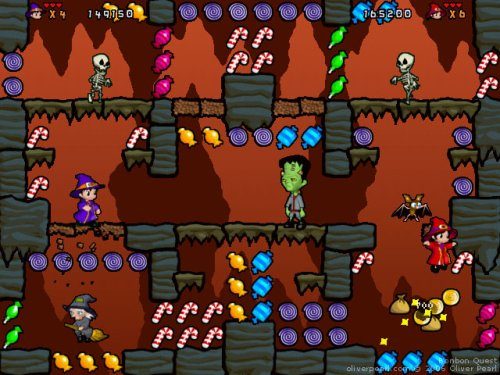
Three screenshots survive from this game rather than the single feature thumbnail most entries have, taken from different points in the game. For a platform title that is the closest thing to a recording that this kind of record offers, and it is the only reason anything can be said about how the game looked in motion — which is to say, almost nothing, but more than none.
A review also preserves the comparisons a writer reached for, and those are historically useful in a way the writer never intended. Reviews of this period measure shareware games against other shareware games and against 8-bit titles twenty years older, almost never against the commercial releases of their own year. That tells you how the audience actually shopped, and no listing page would ever record it.
What is not preserved is the thing that mattered most. A platform game lives or dies on how it feels at sixty frames a second, and no amount of prose recovers that. This entry is a record of a game, not a substitute for it.
The figures the listing carries are worth setting beside the review, because together they describe a complete product in a way neither does alone: fifty-four levels, a mode for one player or two, a requirement for DirectX 8 or later, and a full version at $19.95. The two-player mode is the detail a review could actually test and a description could only announce, and in a platform game of this period it is also the feature most likely to have been the reason somebody bought this one rather than one of the several dozen alternatives on sale that year.
There is one more thing this page can say only because the screenshot is on it. Along the bottom edge of the image above runs an in-game credit — the title, the address oliverpearl.com, and a 2006 copyright line for Oliver Pearl. Neither the review nor the listing names a publisher anywhere in their text, so on this page the picture is the better source, and the studio can be named because somebody put it inside the game rather than in the copy about it. The address still answers today, which is more than can be said for most of the studios in this archive.
One line of the sales copy is more revealing than the price. Ordering was described as safe and secure, from a source the page called well known and trusted — without naming it. A studio selling directly in 2006 could not ask a stranger for card details on its own authority, so it borrowed the authority of a payment processor, and then declined to say which. That sentence is the whole trust problem of the shareware years compressed into a single reassurance that reassures nobody now.
Questions about Bonbon Quest
Does a two-page review mean the game was rated highly?
Not necessarily. It means somebody chose to write at length about it. In a catalogue kept by a very small team that indicates interest rather than a verdict.
Who published Bonbon Quest?
Oliver Pearl, a two-person studio founded in 2005 and based in Brittany, France. Neither the listing nor the review named it — the attribution comes from the in-game credit along the bottom of the surviving screenshots, and the studio address still answers. Checked 3 August 2026.
How many levels does Bonbon Quest have?
Fifty-four, as the listing advertised, playable by one player or two. Those are the seller's figures rather than a count verified here.
What did Bonbon Quest cost?
The full version was $19.95, following a free demo. The page described ordering as being handled by a well-known and trusted source without naming which one, which was normal practice at the time.